Why Consider a Mega Backdoor Roth?
One of the greatest benefits of a Roth account is simple: qualified withdrawals in retirement are generally tax-free. That means any future investment growth can potentially be withdrawn without federal income tax, assuming IRS requirements are met.
For investors who expect to remain in a similar or higher tax bracket during retirement, increasing Roth assets may provide valuable flexibility later in life.
Additional benefits include:
- Increasing tax-free retirement income. Every dollar moved into a Roth account has the potential to grow free from future federal income tax.
- Saving beyond traditional limits. Investors who have already maximized their regular 401(k) contributions may still have the opportunity to contribute additional after-tax dollars.
- Creating tax diversification. Having assets in taxable, tax-deferred, and tax-free accounts provides greater flexibility when managing retirement income and taxes.
- Supporting estate planning goals. Roth IRA assets are generally not subject to required minimum distributions during the original owner’s lifetime, allowing more flexibility in retirement and legacy planning.
Is Everyone Eligible?
Not necessarily. The Mega Backdoor Roth depends entirely on the design of your employer’s retirement plan. Generally, your 401(k) plan must allow:
- After-tax employee contributions (separate from Roth 401(k) contributions), and
- Either in-plan Roth conversions or in-service rollovers of those after-tax contributions to a Roth IRA.
Some plans do not currently offer both features, making it important to review your plan document or speak with your Human Resources department or plan administrator.
How the Strategy Works
Although there are several moving parts, the process typically follows four straightforward steps.
1. Maximize Your Regular 401(k)
Begin by contributing to your traditional or Roth 401(k) through payroll deductions, particularly enough to receive your full employer match. Many investors first maximize their annual employee contribution limit before considering additional strategies.
2. Make After-Tax Contributions
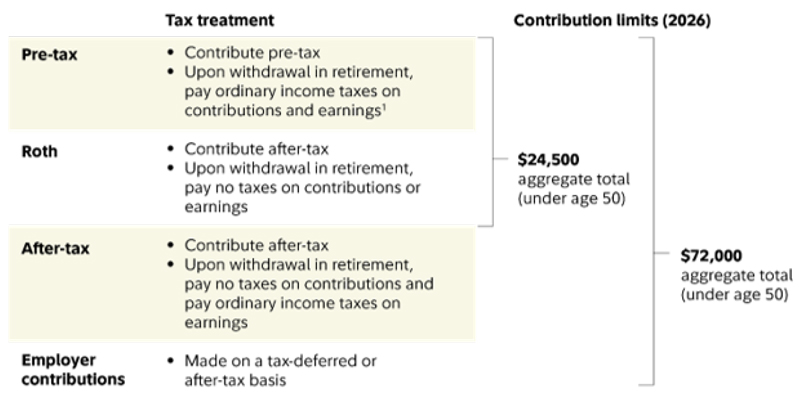
If your employer’s plan permits it, you can contribute additional after-tax dollars to your 401(k). It’s important to distinguish these contributions from Roth 401(k) contributions.
It’s important to distinguish these contributions from Roth 401(k) contributions.
- Roth 401(k) contributions go directly into the Roth portion of your retirement account.
- After-tax contributions are deposited into a separate after-tax account within the 401(k), where they become eligible for conversion.
3. Convert to a Roth Account
Once the after-tax contributions have been made, they can generally be converted into either:
- A Roth 401(k) through an in-plan Roth conversion, or
- A Roth IRA through an in-service rollover, if the plan allows.
Many employer plans now offer automatic conversions each pay period, reducing administrative work and minimizing taxable investment gains before conversion.
4. Allow the Investments to Grow
Once the funds are in the Roth account, they can continue to be invested for long-term growth.
Assuming the applicable holding period and age requirements are met, future qualified withdrawals, including investment earnings, are generally tax-free.
A Simple Example
Consider an investor named Sarah. She has already maximized her annual 401(k) contributions and receives a generous employer match. Because her employer’s retirement plan permits after-tax contributions and automatic Roth conversions, she contributes additional after-tax dollars through payroll.
Each pay period, those contributions are automatically converted into her Roth 401(k), allowing future investment growth to occur within a tax-free account.
Instead of investing those additional savings in a taxable brokerage account, Sarah is able to build a larger pool of tax-free retirement assets that may provide greater flexibility later in life.
Important Tax Considerations
The after-tax contributions themselves have already been taxed, so they generally are not taxed again during conversion.
However, any investment earnings generated before the conversion may be taxable. For this reason, many investors choose to convert after-tax contributions as soon as their plan allows, helping minimize taxable earnings.
Because tax rules can vary depending on an individual’s circumstances, investors should consult with their tax advisor before implementing the strategy.
Common Misunderstandings
The Mega Backdoor Roth is often confused with other retirement savings strategies. Some of the most common misconceptions include:
- Believing every employer offers the strategy.
- Assuming Roth 401(k) contributions are the same as after-tax contributions.
- Forgetting that employer matching contributions count toward the overall IRS contribution limit.
- Waiting too long to complete the Roth conversion, allowing unnecessary taxable earnings to accumulate. Understanding these differences can help investors avoid costly mistakes.
Is This Strategy Right for You?
A Mega Backdoor Roth is often most appropriate for investors who:
- Have already maximized their regular retirement plan contributions.
- Have additional savings capacity each year.
- Want to increase tax-free retirement assets.
- Participate in a 401(k) plan that supports after-tax contributions and Roth conversions.
While the strategy can be highly effective, it requires careful coordination with your employer’s retirement plan rules and an understanding of the applicable tax implications.
Final Thoughts
The Mega Backdoor Roth remains one of the most valuable retirement planning strategies available to eligible employees. For investors seeking to maximize retirement savings and build greater tax flexibility, it offers an opportunity to move substantial additional assets into Roth accounts each year.
As with any advanced planning strategy, the key is understanding whether your employer’s retirement plan supports the necessary features and ensuring the strategy fits within your broader financial plan.