
October’s Handoff: When Tech Stumbled, the Rest of the Market Stepped Up

By Todd Vandam, CFA

For one month, the market split in two. On one side, the technology stocks that have led this market sold off hard: the NASDAQ Composite fell 5.3% and ended October 9% below its peak. On the other side, almost everything else went up. Nine of eleven S&P 500 sectors finished higher, and bonds rallied as yields fell. The question is why that happened, and whether it matters.

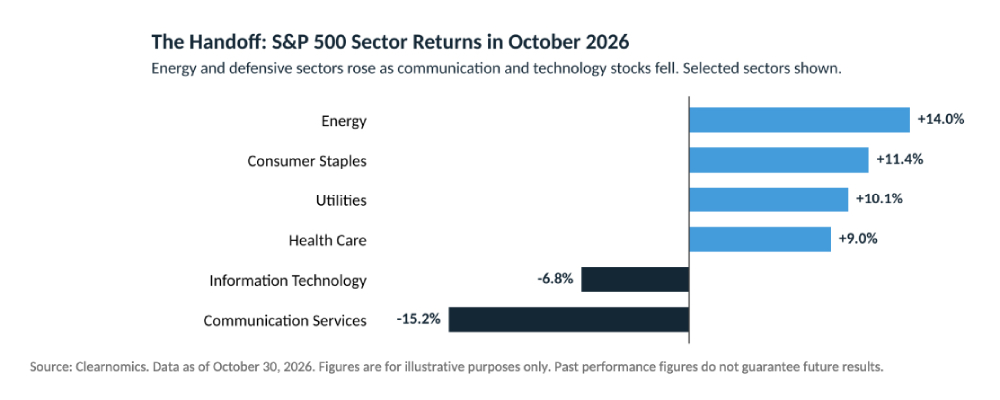
The trigger. Investors started asking what the AI buildout will cost and when shareholders will see the return. That was enough to send Communication Services down 15.2%, the weakest S&P 500 sector, followed by Information Technology, down 6.8%.

The handoff. In past tech selloffs, the broader market tended to follow the NASDAQ lower. This time it did not. Energy led, up 14%, followed by Consumer Staples (+11.4%), Utilities (+10.1%) and Health Care (+9%). Utilities had fallen about 13% in the third quarter, and three of these four leaders are traditionally defensive, so investors were moving toward steadier ground rather than out of stocks. It is the concentration risk we raised in our Q3 outlook, when the ten largest companies made up about 40% of the S&P 500, playing out in real time.

The safety net. Bonds did the job they are hired to do. The 10-year Treasury yield fell 31 basis points to 4.98%, and the U.S. Aggregate Bond Index returned about 2.4%, recovering roughly two-thirds of its 3.5% third quarter decline and helping offset losses in technology. International equities slipped 0.8%, so the cushion came from bonds and from sectors at home, not from overseas.

The foundation. Underneath the volatility, the economy kept performing. Third quarter GDP grew 3.4%, above trend, driven by consumer spending and by business investment in the AI buildout. Most companies reporting results are beating expectations, with earnings growth on pace for 20% plus for the quarter. There is an irony here: the AI spending that spooked investors is also helping hold up the economy. October looks like a repricing of expectations, not a warning about growth.

The wild cards. Oil jumped about 15.2% on concern that attacks on Iran could resume after the midterm elections, which helps explain Energy’s lead. Higher oil feeds inflation, and the Federal Reserve left rates unchanged with inflation still above its 2% target. Oil, inflation and the Fed are now one story, and it is the one we are watching most closely.

Global Market Summary

Global stocks, U.S. sectors and interest rates

Global Stock Market Summary
Index October
S&P 500 -0.9%
NASDAQ Composite -5.3%
International Equities -0.8%

Rates and Bonds
Measure October
10-Year Treasury Yield 4.98% (-31 bp)
Fed Funds Target Range 3.75%-4.00% (unchanged)
U.S. Aggregate Bond Index (return) about +2.4%

Sector Performance (Selected S&P 500 Sectors)
Sector October
Energy +14.0%
Consumer Staples +11.4%
Utilities +10.1%
Health Care +9.0%
Information Technology -6.8%
Communication Services -15.2%

Commodities
Index October
WTI Oil +15% to $104

Source: Clearnomics. Data as of October 30, 2026. October figures are monthly changes; S&P 500 sector figures are shown for the sectors named in this commentary.

What we are watching:

1) The Price of AI: The cost of AI spending is the market’s current concern due to higher prices for compute, power and cost of capital. Whether this economic engine keeps growing and when returns reach shareholders will decide if the economy continues to grow as expected and technology reclaims leadership. We remain constructive on equities because earnings are strong, but we are not comfortable relying on a handful of names. We continue to advocate adding international equities and, for clients with lower liquidity needs, private equity.

2) Oil, Inflation and the Fed: The chain from oil prices to inflation to interest rates is the one to watch. With inflation above target, we are watching how the Fed plans to bring it down. We believe short-term bonds remain a good diversifier at today’s yields, and a lasting end to hostilities would ease pressure on prices and should support risk assets.

3) Diversification at Work: October was the case for owning more than one engine. When the AI-driven part of the market slowed, other stocks and bonds carried the load. We stay focused on the long term, with portfolios that combine U.S. equities, international equities, private markets and fixed income.

4) The Midterm Elections:

Election Results
Democrats flipped both chambers of Congress, winning control of the House and the Senate in a widespread repudiation of President Trump and the Republican Party.

Initial Market Reaction
The first reaction has been concern about the AI buildout, driven by newly elected Democratic governors who opposed data center expansion, which could slow approvals and project timelines. The second effect has been lower oil prices and higher international equities, as Trump told the Financial Times he has no immediate plans for further strikes on Iran. We will continue to monitor the effect of the election results on growth, earnings, and interest rates over the coming weeks.

The information contained herein is for informational purposes only, is not personalized investment advice, and should not be construed as a recommendation to purchase or sell any particular security, sector, or strategy to any individual person or entity. There is no assurance that diversification will help avoid a loss or negative investment performance. Past performance should not be considered as an indicator of future results.

Forecasts of financial market trends that are based on current market conditions constitute Pallas Capital Advisors, LLC’s judgment, and are subject to change without notice. “Expected” return estimates are subject to uncertainty and error. The ability to achieve similar outcomes is subject to risk factors over which Pallas may have no or limited control. References to expected returns are not promises or even estimates of actual returns an investor may achieve.

Alternative asset classes, such as private equity and private credit can offer diversification and greater return potential to an investment portfolio, but they also carry different risks, including illiquidity, valuation complexities, and lower regulatory oversight compared to public investments. Investors should carefully consider their investment objectives, risk tolerance, and the illiquid nature of these assets before investing.

Investment Advice offered through Pallas Capital Advisors, LLC, a registered investment advisor. CRN26_67

The information contained herein is for informational purposes only, is not personalized investment advice, and should not be construed as a recommendation to purchase or sell any particular security, sector, or strategy to any individual person or entity. Past performance should not be considered as an indicator of future results.

Forecasts of financial market trends that are based on current market conditions constitute Pallas Capital Advisors, LLC’s judgment, and are subject to change without notice. “Expected” return estimates are subject to uncertainty and error. The ability to achieve similar outcomes is subject to risk factors over which Pallas may have no or limited control. References to expected returns are not promises or even estimates of actual returns an investor may achieve.

Alternative asset classes, such as private equity and private credit can offer diversification and greater return potential to an investment portfolio, but they also carry different risks, including illiquidity, valuation complexities, and lower regulatory oversight compared to public investments. Investors should carefully consider their investment objectives, risk tolerance, and the illiquid nature of these assets before investing.

Investment Advice offered through Pallas Capital Advisors, LLC, a registered investment advisor. CRN26_41