

PCA Quarterly Commentary

Q1 2025

Navigating Growth Amid 2025 Uncertainty

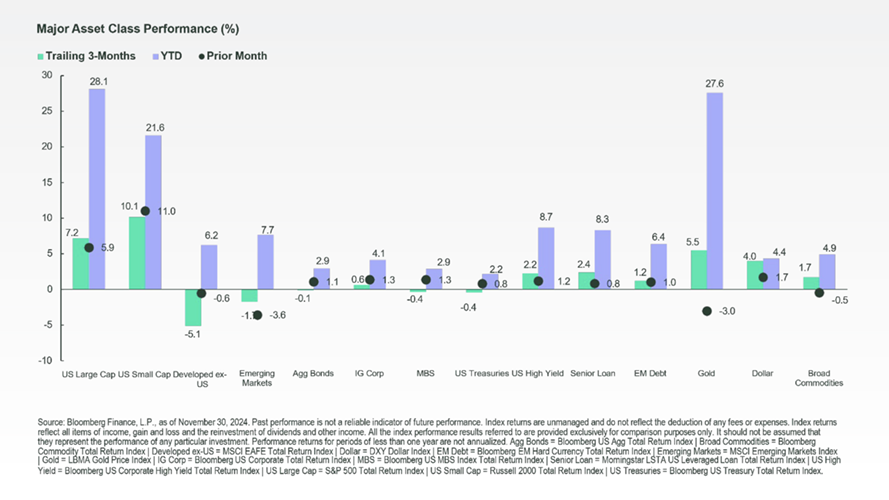
Investors have reason to smile as this year comes to a close, as all major asset classes posted positive returns for the fourth quarter and 2024 as a whole (see Figure 1 below). Markets ignored most geopolitical risk and put their faith in the AI revolution, government-led industrial policy (typified by the Chips Act and the Inflation Reduction Act) and central bankers’ handling of monetary policy.

We expect these trends to carry into the next several years. Technological developments are driving extraordinary innovations in AI and health care. Continuing geopolitical tensions and the probability of higher tariffs globally will likely lead to the reconfiguration of supply chains, disrupted labor supplies and a strong focus on secure energy

transition, all of which support constructive industrial policy. At the same time, the global economy is adjusting to a world in which trend inflation, interest rates and volatility are higher than they have been over most of the past 15 years.

While aspects of this outlook are daunting, we believe on the whole it will bring an opportunity set with breadth and richness not seen since the aftermath of the global financial crisis. We expect earnings growth to broaden across sectors and regions, and we think more asset classes will participate in some of the outlook’s defining themes. As we enter 2025, our main focus in client portfolios is on preserving the capital investors have built while positioning them to take advantage of these themes.

Figure 1

Markets gave investors reason to smile in 2024

Markets-gave-investors-reason-to-smile-in-2024

Themes for 2025

The coming year presents an unusually rich collection of investable themes. We are focused on opportunities related to:

  • Expansion of AI infrastructure
  • The energy transition
  • A global industrial buildout
  • Defense spending
  • Innovation in retail financial products, including liquid exposure to alternatives

2025: Higher for longer

The biggest surprise this year: High interest rates do not seem to have slowed economic growth.

This time last year, while we acknowledged that one could make a reasonable case the economy would experience a soft landing, we expressed greater conviction in the thesis that restrictive monetary policy would sow the seeds for below-trend growth by the end of 2024. We think the most likely explanations

for the economy’s resilience are the combination of lingering pandemic-era fiscal support, solid income growth and increasing wealth due to rising stock and real estate markets.

This healthy fundamental underpinning makes us more sympathetic to the idea that the economy could generate sustained growth over the coming year.

We have upgraded our economic outlook for 2025 to trend-level growth, driven by monetary policy easing and fiscal support from the incoming administration and Congress.

This forecast increases our conviction that inflation is likely to remain sticky for longer than we previously expected. Although we are bullish on transition themes such as supply chain reconfiguring, energy independence and AI, all are inflationary in the near term, and tariffs and immigration restrictions could exacerbate inflationary pressures. We think the annual rate of inflation is likely to hover between 2.3% and 2.8% in 2025.

Our expectation for persistent inflation suggests that keeping real rates at current levels would require keeping nominal yields relatively high. We think the Federal Reserve might keep the federal funds rate in the neighborhood of 3.5% to 4%, and the yield on the 10-year Treasury may hover in the 4.5% to 5% range. These levels wouldn’t be unusual, historically, but they would be well outside the norms of the last 15 years.

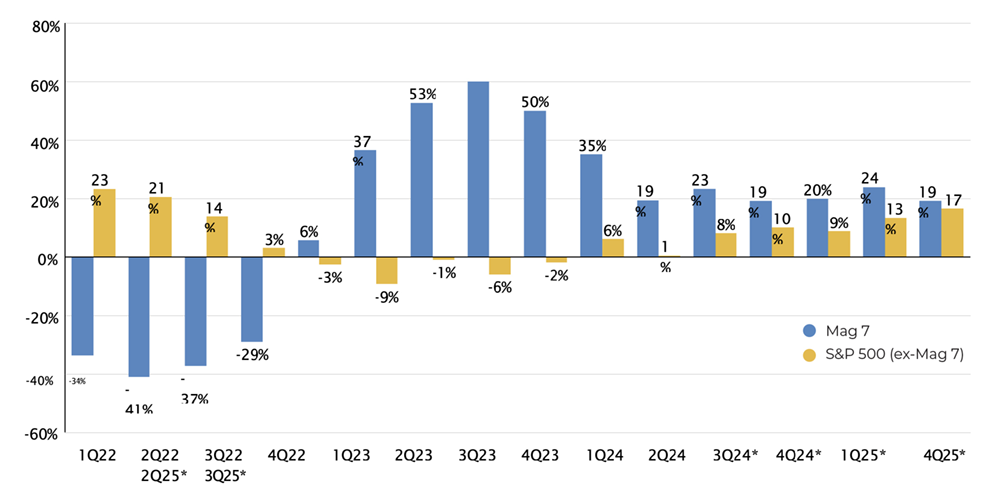
That said, trend-level growth with moderate inflation and positive real rates is likely to create a beneficial environment for growth assets, particularly given the incoming administration’s focus on deregulation and lower taxation and its plans for fiscal spending. This outlook is reflected in market expectations for strong 2025 earnings growth across most global equity markets, including improvement in relative profit growth for companies outside the Magnificent 7 (see Figure 2 below). We expect the equity market rally

to broaden to include small- and mid-cap U.S. stocks and international equities. Meanwhile, positive real rates are likely to lead to more rational expectations for private assets and to curtail exuberance and leverage- inflated returns.

As we consider how to preserve capital and harness the themes we see in today’s markets, we are focused on three primary strategies for deploying incremental assets:

  • Diversify growth assets, broadening sources of potential return
  • Diversify sources of income through new investable themes, being mindful of tax efficiency
  • Build resilience with alternatives

Figure 2

Stocks outside the Mag 7 narrow the earnings-growth gap

As Mag 7 earnings growth decelerates in 2025, the rest of the market catches up

Source: FactSet, J.P. Morgan Asset Management. *Numbers are forecasts based on consensus analyst expectations. Data are as of November 15, 2024. Magnificent 7 includes AAPL, AMZN, GOOG, GOOGL, META, MSFT, NVDA and TSLA. Earnings estimates for 2024 are forecasts based on consensus analyst expectations.

Diversify growth assets by broadening sources of potential return

Why this approach? The ingredients are present for another year of robust U.S. economic growth. Healthy expansion in the United States has spilled over to the rest of the world in recent years, helping offset softness in Europe and China. We expect this dynamic to continue in 2025.

America’s economy outperformed over the past few years not just because consumers spent more, but also because of strong nonresidential investment – driven in part by incentives put in place by fiscal policy. The development of AI related technologies and the green energy transition have been especially important in supporting investment growth. As noted above, we remain concerned about U.S. markets’ valuations and the Mag 7’s weights in broad-market indexes. But as we look at 2025, we believe earnings growth will broaden domestically, supported by higher- quality companies (that is, firms that generate relatively high free cash flow) and by beneficiaries of a expansive industrial policy.

The positive fiscal impulse in the U.S. is fading. That said, fiscal measures such as the Inflation Reduction Act and the CHIPS and Science Act should ensure further disbursement of tax incentives and industry specific grants during the coming years. New policies may provide additional support; for example, the incoming administration’s policy manifesto indicates an appetite for policies intended to boost manufacturing.

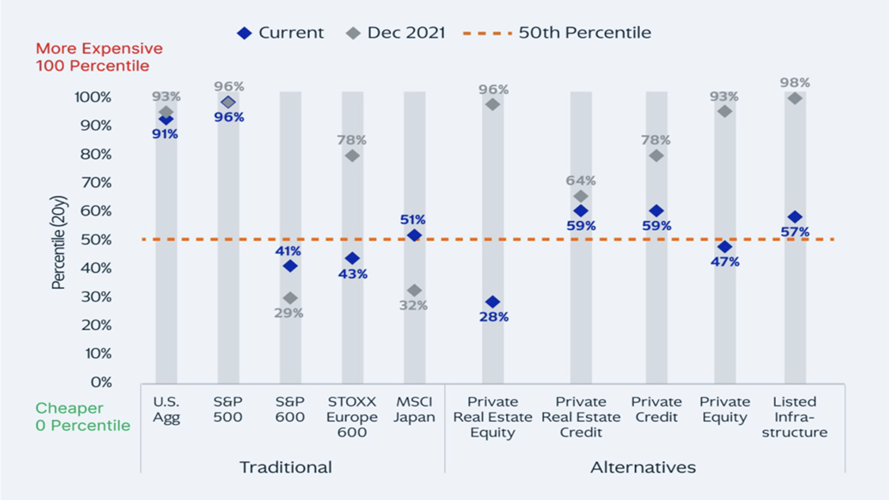
Finally, although international markets have lagged U.S. markets, we see some reasons to be optimistic in 2025. Valuations of most assets, outside of US equities, are compelling (see Fig 3 below). European firms are likely to initiate greater investments in AI and to reap the benefits of easier financial conditions as the ECB continues lowering rates. European companies also offer the potential for attractive buybacks and dividends; for example, European equities recently offered a dividend yield of approximately 4%.

Figure 3

Outside of U.S. stocks, asset valuations look reasonable

Outside-of-US-stocks-asset-valuations-look-reasonable

Source: BlackRock using data from Congressional Budget Office. As of October 15, 2024. For illustrative purposes only. Forward-looking estimates may not come to pass.

How to implement it: Maintain exposure to equities while broadening across sectors, markets and private assets. These include:

  • Quality S. growth stocks: Focus on stocks that could grow into current valuations.
  • Private equity: Private equity valuations have dropped significantly and now are well below public- market
  • Cyclical sectors: Potential growth in domestic manufacturing and infrastructure spending improves the outlook for industrials, materials, financials and other economically cyclical
  • Select international assets: Own quality firms with strong cash flows and the ability to grow dividends, particularly in sectors poised to benefit from broadening investments in AI.

Diversify sources of income

Why this approach? While bonds have been the primary income providers for most client portfolios, we see promising opportunities in alternative sources of income, driven in part by growth in capital expenditures (capex).

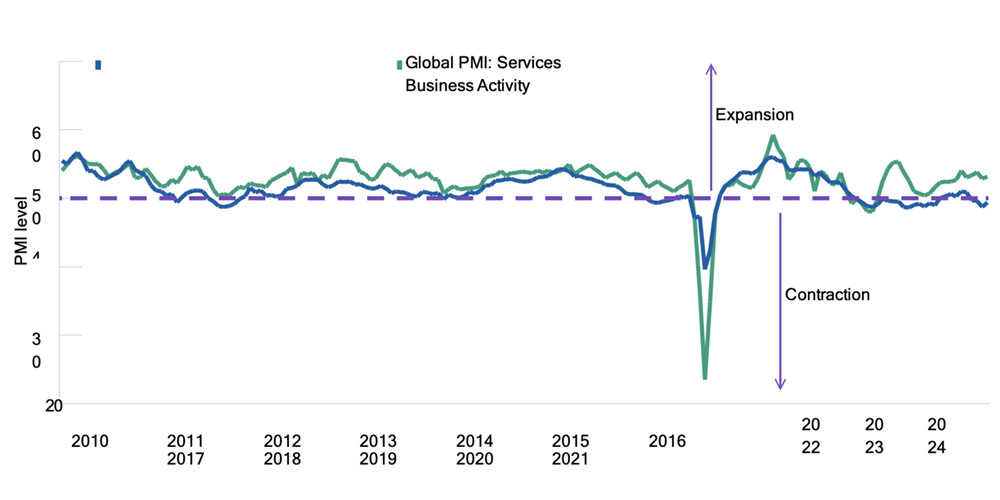
Manufacturing has lagged services for several years (Figure 4). We believe four key drivers could boost capex:

  • The release of pent up demand for consumption of interest rate sensitive goods such as vehicles, houses and large appliances
  • A surge in spending on infrastructure for renewable energy and generative AI
  • The growing trend of companies shifting manufacturing to “friendlier” countries
  • Rising trend of defense spending globally

Each of these drivers will require a major injection of capital. In each sphere, the sectors that provide solutions – including industrials, energy and materials – are likely to attract enormous flows of investment into physical assets in the years ahead.

These developments will play out over many years, but their impact on the global economy is likely to be visible in 2025, particularly in the second half of the year. By then we expect monetary easing to have sparked a global economic recovery characterized by a shift from services to manufacturing, though strength will be inconsistent across regions.

Meanwhile, private credit is expanding to include a broader range of asset types and new sets of borrowers, offering investor new sources of income. They include:

  • Asset-backed finance, particularly segments that feature higher risk-adjusted yields that are attractive to institutional investors, such as aircraft loans and equipment leasing
  • Infrastructure and project finance assets with durations of five years or more
  • Jumbo residential mortgages, particularly those with high loan-to-value ratios and, for nonprimary residences, those classified as “nonconforming” under bank regulations
  • Higher-risk commercial real estate, where banks increasingly seek to reduce their exposure

How to implement it:

  • Private credit, with a focus on asset-back lending and real estate
  • Private infrastructure, emphasizing tax-efficient income through investments that stand to benefit from rising These may fund energy investments for the transition to renewables in Europe; roads, ports and other infrastructure; and AI-related investments in data centers and energy.

Figure 4

Manufacturing is poised for a comeback

Manufacturing-is-poised-for-a-comeback

As of October 31, 2024.

Source: Copyright © 2024, Markit Economics Limited now part of S&P Global. All rights reserved and all intellectual property rights retained by S&P Global.

How to implement it: Maintain exposure to equities while broadening across sectors, markets and private assets. These include:

  • Quality S. growth stocks: Focus on stocks that could grow into current valuations.
  • Private equity: Private equity valuations have dropped significantly and now are well below public- market
  • Cyclical sectors: Potential growth in domestic manufacturing and infrastructure spending improves the outlook for industrials, materials, financials and other economically cyclical
  • Select international assets: Own quality firms with strong cash flows and the ability to grow dividends, particularly in sectors poised to benefit from broadening investments in AI.

Build resilience with alternatives

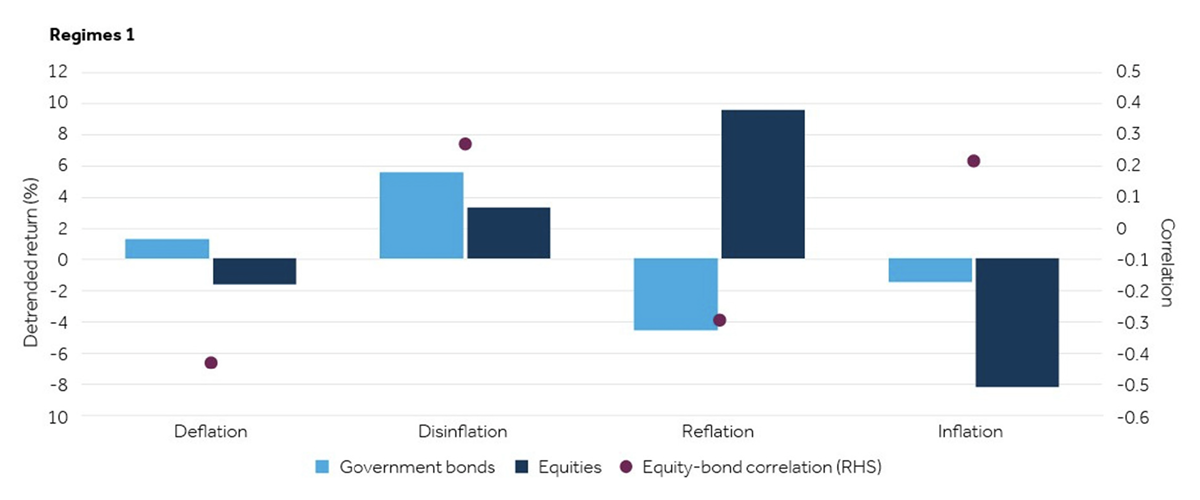
Why this approach? With a higher-for-longer backdrop for interest rates and inflation, correlations between stocks and bonds may remain elevated, potentially undermining bonds’ ability to serve as the main ballast for investor portfolios (see Figure 5 below). High valuations for public equities also could challenge the performance of traditional stock-bond portfolios. For many investors, alternatives offer a potential solution to both problems.

How to implement it: We employ an outcome- oriented approach toward portfolio construction. Each major component of an alternatives allocation – commodities, hedge funds, real assets and private capital – can be used to solve for one or more portfolio challenges.

Alternative assets will become increasingly approachable as technology and financial innovation continue to drive down minimum investments and improve liquidity. These developments will make it easier to incorporate alternatives into client portfolios. For example, the traditional, 60/40 stock/bond framework may evolve into a 50/30/20 portfolio, with reductions in both stock and bond allocations funding the 20% position in alternatives.

We will continue to monitor the markets carefully, and we are prepared to adjust our views as conditions evolve. Please contact us if you have questions about our perspective on the markets or our thoughts on implementing them.

Pursuing outcomes with alternatives

Alternative asset class Intended outcome
Private equity Structural growth with reasonable valuations
Infrastructure Income
Real assets Inflation hedging
Hedge funds Returns uncorrelated to public markets
Buffer ETF’s Exposure to markets with a buffer to protect against sharp moves in markets

Figure 5

Stock-bond correlations change with inflation regimes

As of October 31, 2024.

Source: Copyright © 2024, Markit Economics Limited now part of S&P Global. All rights reserved and all intellectual property rights retained by S&P Global.

How to implement it: Maintain exposure to equities while broadening across sectors, markets and private assets. These include:

  • Quality S. growth stocks: Focus on stocks that could grow into current valuations.
  • Private equity: Private equity valuations have dropped significantly and now are well below public- market
  • Cyclical sectors: Potential growth in domestic manufacturing and infrastructure spending improves the outlook for industrials, materials, financials and other economically cyclical
  • Select international assets: Own quality firms with strong cash flows and the ability to grow dividends, particularly in sectors poised to benefit from broadening investments in AI.

Key Takeaways

  • While our base case points to continued out performance from equities and risk assets, we do believe this is a good time to diversify into areas of the market that offer quality at a reasonable price
  • We believe investors should build hedges in their portfolio especially outside of traditional bonds as inflation takes longer than earlier expected
  • We are excited about the prospects of increased capital spending and a renewed emphasis on manufacturing globally. Along with AI this should offer new investing and income generating opportunities for investors. U.S. exceptionalism should march on for another year!

This newsletter is for informational purposes only, and is not intended to be specific guidance for any investor’s specific situation. An investor should consider the risks inherent in any investment before choosing to invest. Risks may include, but are not limited to, lack of liquidity, lack of transparency (in the case of hedge funds), international and geo-political risks, currency risk, interest rate risk and others. Past performance is not a reliable indicator of future results.